Unconventional AI Announces its Launch with $475 Million in Seed Funding
- Karan Bhatia

- Dec 9, 2025
- 2 min read
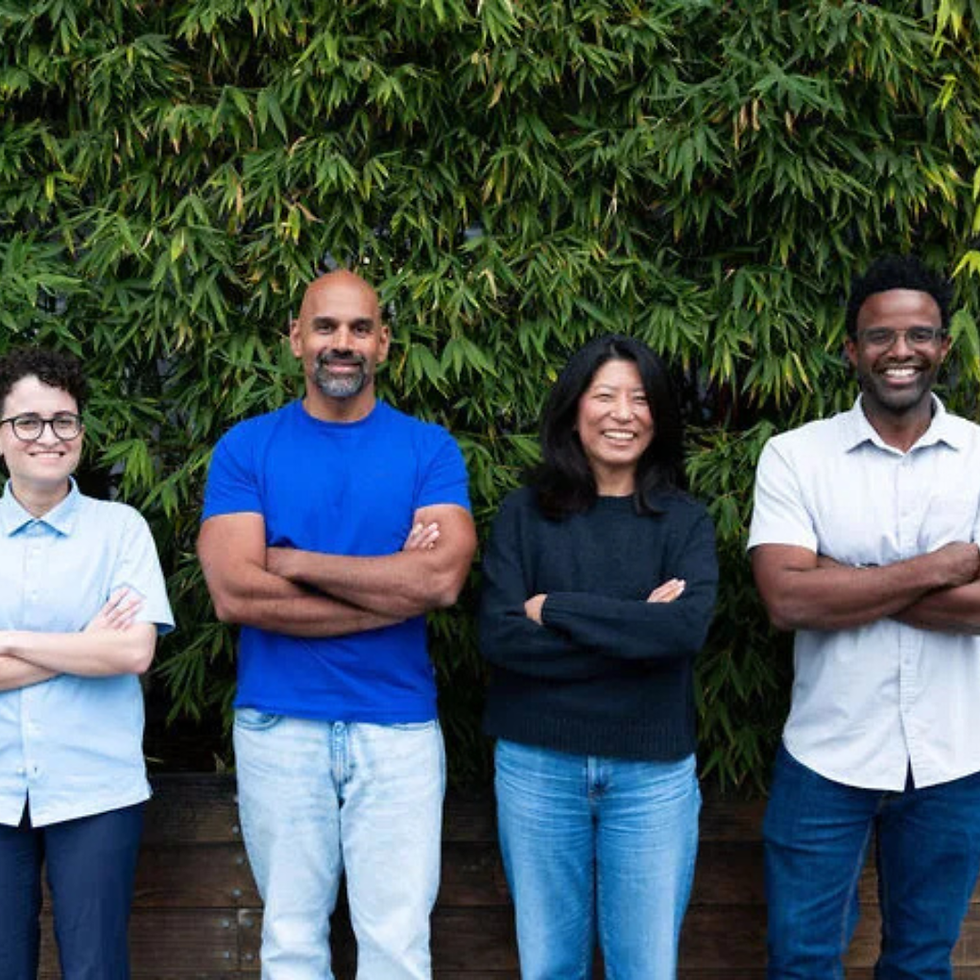
Unconventional AI, rethinking the foundations of a computer to optimize energy efficiency for AI, led by MeeLan Lee, Sara Achour, Michael Carbin, and Naveen Rao, has secured $475 million in seed funding led by Lightspeed and Andreessen Horowitz, with participation from Sequoia, Lux Capital, DCVC, Future Ventures, Jeff Bezos, and many other amazing investing partners, valuing the company at $4.5 Billion. Naveen Rao, cofounder and CEO, will personally be investing $10 million alongside others.
The growing energy bottleneck in AI demands major advances in computational efficiency. One solution mirrors how F1 teams boost aerodynamics: creating a biology-scale model of the intelligence layer inside a silicon “wind tunnel.” Neural networks already have a biological analogue in the human brain, which operates on just 20 watts. Neurons rely on inherent physical properties to produce intelligence, and new silicon circuits are being designed to replicate similar non-linear dynamics. By establishing the right isomorphism for intelligence directly in hardware, this approach aims to achieve efficiency gains that far exceed what digital simulation can deliver.
AI optimism shapes a vision where advanced capabilities become universally accessible. Human inquiry, problem-solving, coordination, and large-scale resource deployment stand to reach unprecedented levels, with AI embedded at the core of global productivity.
Across the past 50 years, intellectual work has grown to dominate economic output. Strategic improvements in labor organization and physical environments have amplified how resources are deployed, and the computer emerged as the defining tool for structuring information. As a result, the technology sector has become one of the world’s largest industries.
Throughout this period, the cost of computation has steadily declined, accelerating innovation and expanding the reach of digital systems.
Falling compute costs have repeatedly expanded how computers are used, from early scientific and military applications to business software, gaming, and now AI. But AI is unlike previous forms of computation. Its sweeping applicability is driving demand so rapidly that global energy limits could become a constraint within the next three to four years.
Scaling AI requires a new computational substrate built for efficiency.
Neural networks are stochastic systems, yet today they run on deterministic digital abstractions layered over analog hardware, creating major inefficiencies. Unconventional AI aims to expose software directly to the physics of silicon so neural networks can operate on real physical dynamics instead of simulated ones. This approach promises far greater capability at a fraction of the energy, guided by a central question: what is the correct isomorphism for intelligence?
Developing this new machine will demand genuinely unconventional thinking. It requires people who can challenge assumptions, reason from first principles, and push beyond established boundaries. The work spans both algorithms and hardware, a true convergence of disciplines. Success depends on extreme codesign, where software and hardware are architected together from the ground up.


