Dream Raises $17M in Seed to Teach AI How to Understand and Build the Physical World

Dream, a product and research company that automates the design and engineering of the built world, led by Andy Elder and Arjun Mathur, has emerged from stealth today with $17 million in seed funding. The round included investment from Andreessen Horowitz (a16z), SV Angel, XYZ, and Zigg Capital, among others. Trained on the largest known dataset of real, permitted buildings, Dream's models reason about the physical world the way large language models reason about text. Dream is starting with architecture, engineering, and construction (AEC), one of the largest and least digitized industries in the world.
Dream Develops AI Models for Building Design.
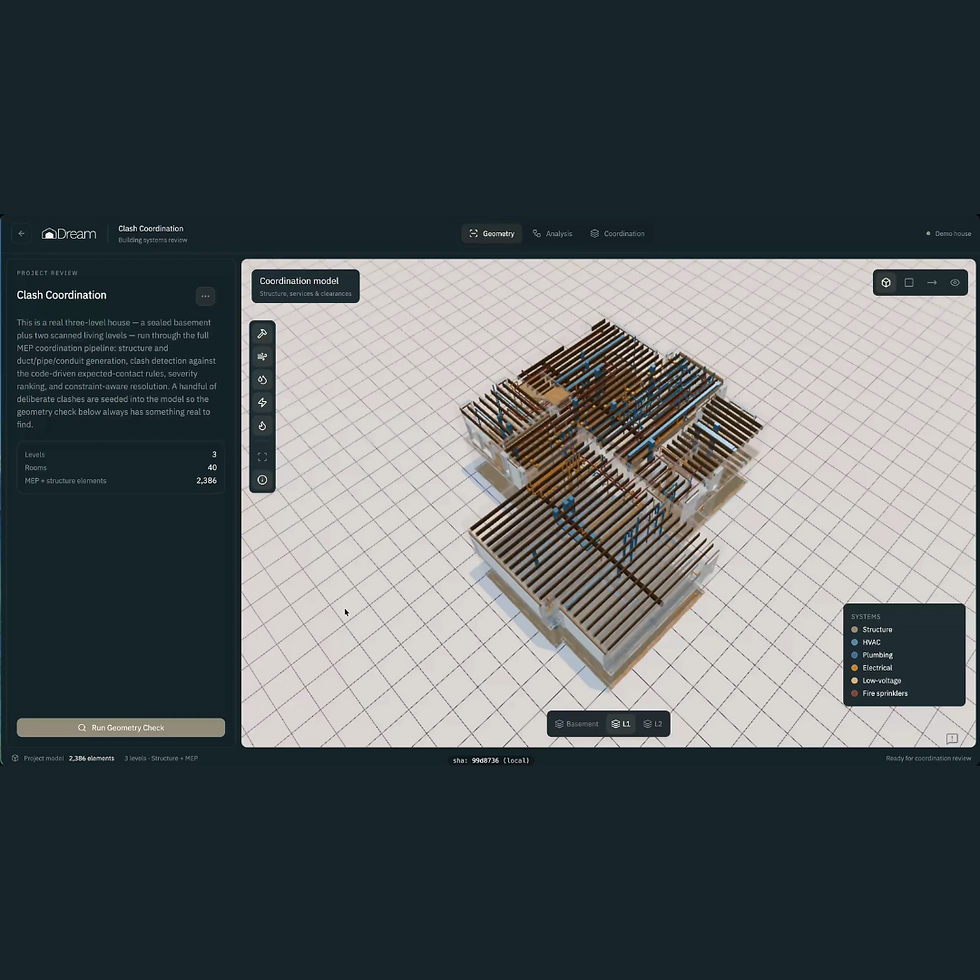
Dream is introducing Built World Models, AI trained to understand 3D spaces, geometry, and physical constraints involved in building design and engineering. Its technology, called Structural Cognition, enables AI to reason about how building components fit together, including HVAC systems and other infrastructure.
Trained on more than 100 million square feet of permitted U.S. buildings, the models aim to generate engineering-grade, spatially precise building plans.
“There is no room for probabilities when it comes to buildings and infrastructure,” said Andy Elder, co-founder of Dream. “A hallucination in an LLM is a typo. A hallucination in a building is a structural fault, with potentially catastrophic consequences. We built Dream to be exact, down to how a duct routes through a wall, because precision at that level is what actually shortens timelines and takes cost out of a project.”
Founded by Andy Elder and Arjun Mathur, Dream brings over a decade of experience building mission-critical systems at Palantir to the AEC industry. Elder led global design teams across defense, intelligence, and commercial sectors, while Mathur built Palantir’s manufacturing and supply chain practice. Their experience working with complex physical systems and real-world constraints now shapes Dream’s approach to AI-powered spatial reasoning.
“Almost every other industry has found its AI unlock. We’re building that unlock for AEC, an industry responsible for designing and building the physical world we live in: our homes, our schools, where we work. This is a new category of AI that brings spatial reasoning to the built world, and eventually, any 3D design project beyond buildings,” said Arjun Mathur, co-founder of Dream.
“AI that can reason in three dimensions is the next frontier, and Dream is building a model that can actually do it,” said Kimberly Tan, Investing Partner at Andreessen Horowitz. “Their technology has the potential to bring a multitrillion-dollar industry still reliant on software built in 1997 into the AI era. We backed Dream because we believe spatial reasoning will fundamentally change how the physical world is designed and built.”
Dream has served as architect of record for 10 construction projects across California and Texas, including a completed single-family home in Austin. The company has supported $20 million in project developments to date.


